Cycling in Yorkshire & Beyond

Cycling in Yorkshire & Beyond

Stage One | Stage Two | Stage Three
This is a guide to Stage Two of the Way of the Roses from Burnsall to York. It includes a video, route notes and images.
This stage is 57 miles, which is about one third of the total distance of the Way of the Roses. If your accommodation is on the far side of York, you'll do a few more miles and leave a bit less for Stage Three.
This is a video of the route of Stage Two of the Way of the Roses.

My Stage Two of the Way of the Roses starts at Burnsall.
Cross the bridge over the Wharfe at Burnsall and ride along a minor road called Cross Hill, past Hartlington Hall.
The picturesque village of Appletreewick is on the route after a mile and a half.

Appletreewick is a bit of a mouthful, so locals shorten it to 'Aptrick'.
In the late 1500s, William Craven set off from Aptrick to make his fortune in London. He became a wealthy merchant and was made Lord Mayor of London in 1610.
There are similarities to the story of Dick Whittington - but the story of the young man who had heard that the streets of London were paved with gold was first recorded in 1605, so it cannot refer to Craven.

Soon after Appletreewick the climb of Greenhow Hill begins.
Climbing steeply you pass the turn onto Skyreholme Lane, which leads to Skyreholme and Parcevall Hall. The Hall is owned by the Anglican diocese of Leeds.
The gardens of Parcevall Hall were laid out in 1927 with plants from western China and the Himalayas. The gardens are open daily in Spring and Summer, with an admission charge, and there is a tea room.

Continue past Whithill Pasture and Appletreewick Pasture, with alternating sections of flat and uphill.
Then turn right on the B6265 Hebden Road - one of the worst bits of this route.

At times there can be significant amounts of traffic, with many drivers going fast and some passing too close. In my view, a road like this would not be acceptable on a long-distance cycle route in a country that took cycle touring seriously.
Pass Stump Cross Caverns. They have a café.

You reach Keld Houses, then the village of Greenhow.

Greenhow Hill Top is up to the right of the road, and the village is strung out along the road.

There was lead mining on Greenhow Hill from Roman times, with the local Brigantes tribe forced to work in the mines.
In Medieval times, the monks of Fountains Abbey had the mineral rights here.
Sir Stephen Proctor obtained the rights in 1597, and built the first smelt mill as well as the village. By the late 1800s, most of the easily-accessible lead had been extracted and there was competition from cheap imports.
Between 1870 and 1895, most of the mines closed.
Now limestone aggregate is quarried at Coldstones Quarry.
There is a public artwork at the quarry called Coldstones Cut, by Andrew Sabin. The path up to it starts at the junction of the B6265 and Peat Lane.
There's also a monumental bicycle at Coldstones Cut, made by quarry workers to celebrate the 2014 Grand Départ of the Tour de France.

The altitude gain on the climb of Greenhow Hill from Appletreewick is around 228m over a distance of 9km. The top is at 397m.
The descent starts as you pass Coldstones Quarry. A sign warns cyclists to be careful of the steep gradients.

You arrive in Pateley Bridge at the Royal Oak pub.


Pateley Bridge is a market town in North Yorkshire.
It has a history of quarrying and brewing. Until 1964, the Nidd Valley Railway linked Pateley to Harrogate.
The Nidderdale Museum has lots of interesting exhibits which illustrate the dale's past.
Pateley Bridge has plenty of pubs, cafés and shops, including England's oldest sweet shop.

Ride up the High Street, and leave Pateley Bridge on the B6165 Ripon Road to Glasshouses and Wilsill.
Wilsill was the main settlement in the dale when the Archbishop of York was the landowner here (from just before the Norman Conquest of 1066 and continuing for centuries).
Alan Bennett was evacuated from Leeds to Wilsill for a few weeks from September 1939, at the start of World War II. He and his family lived at Byril Farm.

At Wilsill, turn off the B6165 on Brimham Rocks Road to Smelthouses.
There's a climb from Smelthouses, with a height gain of 121m over 2km.
At the top of the hill, turn left on what is either still Brimham Rocks Road, or Brimham Moor Road. Pass the entrance to the National Trust car park for Brimham Rocks.

Brimham Rocks is a National Trust site with distinctively-shaped millstone grit rock formations.
Millstone grit is a type of sandstone. The rock was laid down over 300 million years ago, but the weathering that caused the current outcrops happened in the last 100,000 years.
The rock fractured while still buried, then it was exposed by glacial action. Weathering and erosion by water and wind removed the loose material between the outcrops and blasted the rocks.
In the 1800s, visitors to the spa resort of Harrogate took carriages to Brimham Rocks.
Brimham Rocks is designated a Site of Special Scientific Interest.
There is a charge for car parking, but the site itself is free.
Beyond Brimham Rocks, turn right on Warsill Road, which is nice and quiet.
Turn right at a T-junction on Careless House Lane, which is busier, then onto Watergate Road - a really lovely lane.
At times I have seen hares here.

Pass How Hill on your left. It has a folly on top, built in the early 1700s
for John Aislabie of Studley Royal; it was the site of a chapel from
the 1300s, erected by the monks of Fountains Abbey and dedicated to St
Michael the Archangel (or St Michel de Monte).
A little further on you can see Fountains Hall and Fountains Abbey over the wall to your right before you pass the western entrance to Fountains Abbey.

Fountains is a ruined abbey within a wider estate, looked after by the National Trust.

Fountains Abbey was founded in 1132 when thirteen monks split from St Mary's Benedictine Abbey in York.
The breakaway team successfully applied to join the Cistercian order.
Fountains became wealthy, with agricultural land and interests in mining, quarrying, iron-smelting and milling.
By the 1500s it was rich and successful, but Henry VIII had his eye on the wealth of the monasteries.
Climb away from the river Skell, then turn right towards the main Fountains/Studley car park, go straight on at a roundabout, and turn right into Studley Royal near an obelisk.

Studley Royal is a deer park, and part of the same National Trust-owned estate as Fountains Abbey.
The deer park and garden were created by John Aislabie, after his disgrace during the South Sea Bubble scandal, when he was forced to abandon political life.
The former Studley Royal House burned down in 1946, but the stable block remains. There's also St Mary's Church in the deer park, built in 1870.
It's not just deer that thrive in the park, but other wildlife too.
Leaving the deer park, ride up through the village of Studley Roger, then turn right on the B6265 Studley Road (can be busy).
At a mini-roundabout, fork right on Mallorie Park Drive/Skellbank/Somerset Row. At the lights, turn left up towards Ripon Market Place.

The Way of the Roses takes you up one side of Ripon Market Place then down the other.

Ripon is the third smallest city in England, with a population of 17,248. It's at the confluence of the rivers Laver, Skell and Ure.
St Wilfrid is regarded as the founder of Ripon. He was the abbot of a monastery here, and had the first church built.
Ripon was given to the Archbishops of York, and they held a market from the 1100s or 1200s.
The Wakeman was in charge of the market, and of enforcing a curfew. He employed a Hornblower to set the watch, and the Hornblower still blows a horn in market place every evening.
Cross the Iron Bridge over the Skell and take Bondgate south, away from Ripon. Knaresborough Road and Littlethorpe Lane lead to a crossing of the busy A61 Ripon bypass.
Continue on Littlethorpe Lane to Littlethorpe.
At the junction where Littlethorpe Church stands, turn right on Pottery Lane and continue to a T-junction with Knaresborough Road. Turn left to Bishop Monkton.

Turn left in Bishop Monkton and go through the village. Leaving it, follow the Boroughbridge Road east.
This is a quiet country lane that more or less follows the course of the river Ure. It brings you to Roecliffe.

From Roecliffe, you're on Bar Lane which takes you under the A1M and brings you to a busy roundabout of the A168.
Go straight on at the roundabout and pass the Devil's Arrows standing stones (one on your right and two on your left).

Continue to a T-junction in Boroughbridge, where you do a left-right dogleg - left on Horsefair and right on St Helena. You arrive at St James Square, Boroughbridge.

When you reach Boroughbridge, you've done 88 miles; 85 is half-way, so you're into the second half of the ride.
The sign pictured above is at the Peggy Bridge over the river Tutt, on St Helena.

Boroughbridge is a town in North Yorkshire with a population of around 3,600 people.
It was an important stage between Edinburgh and London in the era of stagecoaches (late 1700s to early 1800s), and had twenty-two inns.
Its neighbour Aldborough is a backwater now, but was an important Roman town called Isurium Brigantum. It was on Dere Street, the route north from York.
English Heritage runs the Roman site at Aldborough.

From Boroughbridge head the short distance east to Aldborough.
In Aldborough, pass the Battle Cross which commemorates the Battle of Boroughbridge in 1322, and St Andrew's Church.
The church tower is built with limestone blocks from the Roman forum.

Leaving Aldborough, continue east south east on Holbeck Lane, which is largely flat, and roughly follows the course of the Ure.
The first village you reach is Lower Dunsforth. Continue on Beck Closes Road/Howe Field Road towards Upper Dunsforth.
Just before you get there, Dunesforde Vineyard is on your right.
It is a 'boutique vineyard' of just 4 acres, inspired by the idea that the Romans probably grew grapes and made wine in the area. The vineyard's white and rosé wines have won awards. They also do events, tours and tastings.
The next village after Upper Dunsforth is Great Ouseburn.

Great Ouseburn Village Store has a café.
The village takes its name from the river Ouse, which has its source nearby at Cuddy Shaw Reach where Ouse Gill Beck meets the Ure. (In reality, the Ouse is a continuation of the Ure).
There's a plaque in Great Ouseburn in memory of Russian officers and British Air Ministry staff who died in a plane crash here on 30th April 1942.

Leaving Great Ouseburn, turn left down Boat Lane towards Aldwark Toll Bridge.

The bridge is free for people on bikes.
On the other side of the bridge, take the first right to the disused Linton-on-Ouse airfield and the village of the same name.
Continue to Newton-on-Ouse.

Newton-on-Ouse has two pubs, the Dawnay Arms and the Blacksmiths Arms.
From Newton-on-Ouse, the official Way of the Roses route is on New Road, going around the outside of the grounds of Beningbrough Hall.
There's nothing to stop you going through the grounds of Beningbrough Hall, and it's worth doing so if you want to see this National Trust property.

Beningbrough Hall is a stately home which was built by John Bourchier in 1716 in an Italian Baroque style.
It was inspired by his European Grand Tour.
The hall was passed down through the family, and when the last of the Bourchiers died it was left to the Dawnays. They owned it from the early 1800s until the First World War. Then Lady Chesterfield and her husband the Earl of Chesterfield acquired it.
Lady Chesterfield moved to Home Farm during World War II, and the hall was occupied by the Royal Air Force, and by the Royal Canadian Air Force. It was safer here then living on site at Linton-on-Ouse airfield.
Lady Chesterfield died in 1957, and the National Trust took on the hall in 1958.
The Baroque interior decoration of the hall is interesting, and the Great Staircase impresses visitors. Fancy 'state beds' are a feature of the hall, and the wood carvings of William Thornton are another attraction.
Graffiti carved into the wood above a fireplace, '1942 Gipsy Olie', refers to a wartime love affair between a Canadian airman and a British girl.
You can also see the silver seal of the Bourchier family which a John Bourchier used in 1649 as one of the signatories to the death warrant of King Charles II.
The hall has extensive parkland with a lot of trees, most of them planted in the 1800s.
A ha-ha (sunken wall) prevents livestock from entering the gardens.
The Walled Garden contains a lot of fruit trees, some of them against the wall espalier-style.
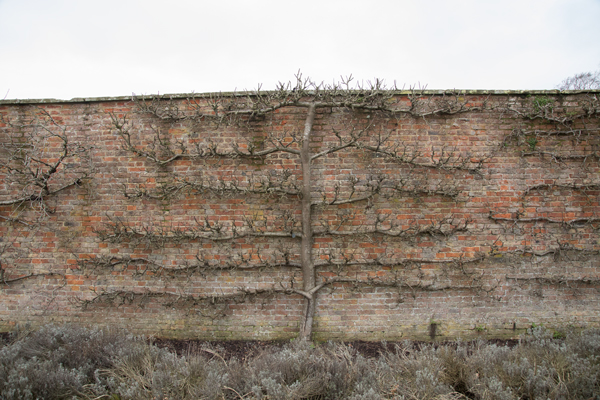
There's a café-restaurant called the Walled Garden.

The American Garden is rather more natural than the other gardens, and it has a nature pond where I saw a lot of frogs at the end of February.

Leaving Beninbrough Hall behind, take New Road/Beningbrough Lane.
It's a single track road with passing places. Not all drivers are considerate: some drive straight at you because you're riding a bike, expecting you to get out of the way (and doff your cap and tug your forelock, probably).
At the next T-junction, turn right on Shipton Low Road (busy-ish) and cross the East Coast Mainline near Shipton-by-Beningbrough.

Pass the Sidings railway carriage accommodation.

Soon after, there's a new bit of cycle path around a commercial development. It brings you out on Overton Road, which goes over the railway again.
Go through the hamlet of Overton.

The road, now called Stripe Lane, takes you under the railway. Soon after, turn right on the cycle path to York.

Initially, it runs alongside Hurns Gutter. Cross it on the little red bridge.

Go through the woods and reach the Ouse. The path follows the river, then diverges away from it at Rawcliffe Landing.

Go under the A1237 Outer Ring Road, pass Rawcliffe Bar Park & Ride, and follow the path across Rawcliffe Ings.
Next, there's a new path across Clifton Ings - it takes a very slightly different line from the old path, and the new path was built as part of flood works by the Environment Agency.
Go under Clifton Bridge, near the Youth Hostel.

Continue on Joseph Rowntree Walk to Scarborough Bridge.
After going under the bridge, turn left away from the river on Railway Walk then St Mary's.
Turn right on Bootham to Bootham Bar, then fork right on St Leonard's Place. At the T-junction at the end, turn left on Duncombe Place, and the Minster is in front of you.

Stage Two finishes at York Minster, in the heart of the city.

York is a city with a long and rich history.
Because of its Roman, Anglian, Viking and Medieval past, it is one of the most interesting and popular places to visit in Britain.
The Minster is at the heart of the city, surrounded by narrow streets packed with cafés and shops.
The city walls make near-complete circuit of the city and are great fun to walk.
The Yorkshire Museum, the Jorvik Museum, Clifford's Tower, York Castle Museum and the National Railway Museum are among the city's top attractions.

The 1:50,000 OS Landranger map number 98 Wensleydale and Upper Wharfedale covers the second part of the Way of the Roses cycle route.
OS Landranger 98 on Amazon (affiliate link).

Pateley Bridge is on the 1:50,000 OS Landranger map number 99, Northallerton and Ripon.
As an Amazon Associate, I earn from qualifying purchases.
