Cycling in Yorkshire & Beyond

Cycling in Yorkshire & Beyond

Stage One | Stage Two | Stage Three
Here are a video and route notes for Stage One of the Way of the Roses, from Morecambe to Burnsall.
This stage is 52 miles, which is about 5 miles short of one third of the total distance of the Way of the Roses. Stage One includes the Yorkshire Dales, so it's the hilliest and hardest stage.
This is a video of the route of Stage One of the Way of the Roses.

The Way of the Roses starts at Morecambe.

The fourth inlet north of Wales has been called Morecambe Bay since Roman times, but the town itself is an amalgamation of three hamlets that came about in 1889.
Morecambe's railway history began in 1848, and the railway was key to a hundred golden years as a holiday resort for the masses.
In recent decades, Morecambe has undeniably been in decline.
It's future could be as a nice, calm seaside resort with attractions including the restored Midland Hotel and the planned Eden Project North.

The start point of the Way of the Roses is on Morecambe Promenade.
The route sets off east along Central Drive, past the Tern Project cormorant sculptures in the middle of the roundabout between The Platform and Aldi.

It is a shame that the Way of the Roses starts with such terrible, outdated cycle infrastructure - narrow, painted advisory cycle lanes on a busy roundabout, then on a busy dual carriageway.
There's a right turn onto Hilmore Way, then a left onto a path by the railway line.

Where you cross a driveway to Domino's takeaway pizzas to reach the railway path, there's a special crossing (Bay Rose crossing), and a plaque which explains its background.

The crossing is a project of the People's Jury on Climate Change in association with Lancaster City Council.
My first thought was that if this is what Lancaster is doing to address global heating, then we're all doomed. If the council wants to do something useful for cycling, it should improve the infrastructure on Central Drive to minimum standards.
My second thought was that I was probably being unfair. The People's Jury is involved with some other projects such as the decarbonisation of Salt Ayre Leisure Centre, and the purchase of electric bin trucks.
Follow the railway path to the Level Crossing, where you cross to the other side of the tracks.

Continue on the railway path, on the other side of the modern railway.

The path is on the original 1848 Morecambe to Lancaster line, built by the Morecambe Harbour & Railway Company, and taken over by the 'Little' North Western Railway.
When you get to Lancaster, cross the river Lune on Millennium Bridge.

Lancaster is next on the route.

Lancaster is a city on the river Lune and the Lancaster Canal. It has a population of around 52,000 in the city itself.
It started out as a Roman fort, and the castle on that site has remained important over the centuries.
The Port of Lancaster thrived from trade in spices and slaves.
By the river Lune in Lancaster there's a dodgy underpass at Greyhound Bridge, then you go under Skerton Bridge.
Next you pass the Alexandra Barracks, and your right there's a bike shop.

Then you go under the Lune Aqueduct, which takes the Lancaster Canal over the river.

After the aqueduct, the Way of the Roses goes under the M6. Here there's an artwork called When Traffic Cones Take Root, by Renn and Thacker. It is one of several sculptures that make up the River Lune Millennium Park, along the riverside path from central Lancashire east to Caton.
Next, the path goes through a car park at the disused Halton Station.
A little further on, you come to a bridge over the river at Crook of Lune.


The artist JMW Turner painted a view at the Crook of Lune.
Crook of Lune car park has a snack bar and free WCs.

Leaving Crook of Lune, you go uphill for a couple of hundred metres on quite a busy road with a terrible surface, before turning off to the right on a genuinely quiet lane (Park Lane).
Park Lane takes you steeply up Halton Hill, then up again through Wham Wood to View Field.
Turn right on Kirkby Lonsdale Road, then take Aughton Road and Fall Kirk to Gressingham. Cross the river Lune to reach Hornby.
Hornby has a castle (now a private residence).

There's also a village store and a tea room.

Turn left on the B6480 Hornby Road to Wray. The B-road is busy and unpleasant.

Wray has a pub, a café - Bridge House Farm Tearooms - and a village store.

After Wray, you cross the river Hindburn and follow it to Mill Houses, where you fork right on Mewith Lane. Then there's a short, sharp climb away from the river.
Now there's a long ride on Mewith Lane, with the Forest of Bowland National Landscape to your right, and views ahead towards the Yorkshire Dales.
You leave Lancashire and enter North Yorkshire.

At a crossroads is Paxtons agricultural garage.

Mewith Lane changes name a couple of times, but it's always the same rolling terrain. It's called Reeby's Lane where it reaches Keasdon.
At Keasdon, turn left towards Clapham Station.

Then it's a short distance to Clapham.

Clapham is a village built either side of Clapham Beck. Its church dates back to 1160, although most of the current building is older.
Ingleborough Hall is the largest house in Clapham. It once belonged to the Farrer family, who are still the biggest landowners in the area.
Botanist and plant-collector Reginald Farrer is perhaps the best-known of the family, and the nature trail from Clapham is named after him. It leads to Ingleborough Cave.

Above Ingleborough Cave is Gaping Gill, then higher still the summit of Ingleborough.
Leave Clapham on the B6480. Where it meets the A65, there's a gravel path that avoids the A-road.

Continue on a minor road to the next village on the route, which is Austwick.

Whereas Clapham's name is Anglo-Saxon, Austwick's is Norse. It was named by Lancashire coast Vikings from Norway, and means 'east farmstead'.
Austwick has a village store.

There's also a pub called the Game Cock, which doubles up as a bakery.

When you leave Austwick, the Norber erratics are up to your left.
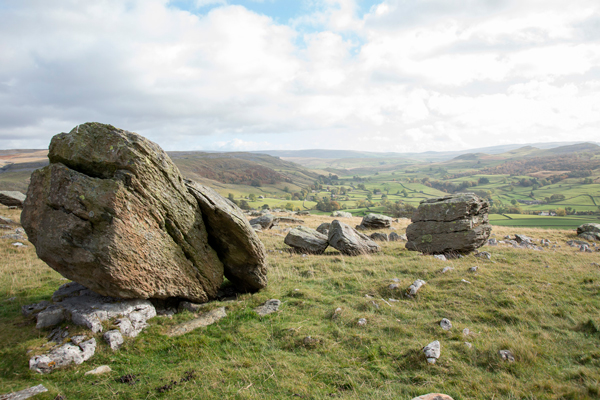
The Norber erratics don't belong here - they were carried by a glacier, then deposited here when it melted around 12,000 years ago.
In fact they didn't travel very far, only about 1km from a rock formation in Crummack Dale.
They are Silurian greywacke, whereas the underlying rock at Norber is Carboniferous limestone. The greywacke is covered in green lichen and the limestone in white lichen.
Some of the erratics are perched on pedestals of limestone; the greywacke has protected that limestone from erosion.
The route crosses Austwick Beck then climbs towards Dry Rigg Quarry.

Near the quarry, turn right and descend towards Little Stainforth and Settle.
Little Stainforth is very close to Stainforth Force.

Stainforth Force is a cascade waterfall on the river Ribble.
The water is brown, as though someone upstream had rinsed out a thousand Marmite pot.
In late October, salmon leap the falls on the way to their spawning grounds higher up the river.

Continue downhill past Stackhouse, and reach the B6480. Turn left on it and cross the river Ribble to Settle.

Continue under the railway until you reach Settle Market Place. There are discreet (easily missed) blue Way of the Roses signs here indicating that you turn left.

Settle is a market town in the Craven district of North Yorkshire. The population of Settle is 2,714 (2021 census).
It is thought to have been founded by the Angles in the 600s, since 'settle' is the Anglian word for settlement. Settle's Royal Charter for a market was granted by King Henry III to Henry de Percy, Baron of Topcliffe, in 1249.
The 3 Peaks Bike Shop is located in Market Place Settle.

From Settle Market Place, take High Street, then ride past the Folly Museum.

There are some cobbles on School Street, which brings you up to Junction Lodge - a house that's had to go on a diet.

Then continue on Victoria Street and Albert Hill to High Hill Lane. A sign indicates that the gradient is 20%.

After a quarter of a mile there's another gradient sign, this one 12%. It felt to me as though some of the 12% sector was just as steep as the 20% part.
Pass Scaleber Wood on your right. In the wood, there's a waterfall called Scaleber Force.
Climb to the top of the hill, which is High Side at 388m.
As the descent starts, take the right fork, Settle Road.
You arrive in the village of Airton.

There's bunkhouse accommodation at Airton Quaker Meeting House.
In Airton, just off the Way of the Roses, is Town End Farm Shop and Café.

Tom Kerridge's BBC2 series Top of the Shop was set here. Food producers tested out their products on the shop's customers and were judged by some judges.
Leaving Airton the road, Abbey Hill, is very much rolling not flat terrain. It takes you to the hamlet of Winterburn.

There's more rolling terrain through the Winterburn Hills to Hetton.

The Angel at Hetton does accommodation and food cooked by Michelin-starred chef Michael Wignall. It featured in a programme called The Trip when Steve Coogan and Rob Brydon had an outdoor breakfast here.
The road from Hetton to Cracoe is rolling once again.

Join the B6265 at Cracoe.
It's unpleasant, with a 40mph limit through the village and quite a lot of HGVs, some of them serving nearby Swinden Quarry.
Mercifully, you soon turn right on Thorpe Lane.
There's yet more up and down on Thorpe Lane, past the Cracoe Reef Knolls.

The Cracoe Reef Knolls are the remnants of an ancient coral reef which formed in a shallow sea about 330 million years ago. They include Kail, Elbolton, Stebden, Skelterton and Butter Haw Hill.
The knolls are reefs on shelf limestone. The reefs were made up of corals and algae. As the shelf limestone sank, the reef creatures wanted to be near the surface. They lived on mud mounds, and grew faster in order to stay near the surface and the sunlight.
Coral and shell fossils can be found on the knolls.
After crossing Thorpe Beck at Thorpe, passing Skulberts Hill, and going over Sandbed Beck, you arrive in Wharfedale at Burnsall.

Burnsall is a small village on the Wharfe.
Its primary school is in what was originally a grammar school, built in 1602. The Burnsall Classic fell race is held every August.
Burnsall has an ice cream parlour, and the Wharfe View Tea Rooms.
There are two relatively upmarket hotels, the Fell Hotel and the Red Lion.

Accommodation is also available in nearby Grassington, or a mile or so further along the Way of the Roses in Appletreewick.
If Appletreewick is too much of a mouthful you can do as the locals do and call it 'Aptrick'.

The Bell Busk Bumble mountain bike ride is covered by the 1:50,000 OS Landranger map number 98 Wensleydale and Upper Wharfedale.