Cycling in Yorkshire

Cycling in Yorkshire
Stage 15 | Stage 16 | Stage 17

Stage 16 of the Tour de France 2022 is from Carcassonne to Foix. It's classified as hilly. The first half is on rolling terrain, but after Tarascon the parcours takes the riders into the Pyrenees, with climbs of the Port de Lers and the Mur de Péguère. The stage ends with a descent to Foix.
Christian Prudhomme thinks this could be a day for a breakaway.
This is the Stage 16 TDF 2022 Blog.
| Date | Tuesday 19th July 2022 |
|---|---|
| Stage classification | Hilly |
| Distance | 178.5km |
| Intermediate sprint | Lavelanet |
| Climbs | Côte de Saint-Hilaire (Cat. 4) Col de l'Espinas (Cat. 3) Port de Lers (Cat. 1) Mur de Péguère (Cat. 1) |

There's an annoying video map of Stage 16:
This is the profile of Stage 16, Tour de France 2022:

| Caravan | Fast Schedule | Slow Schedule | |
|---|---|---|---|
| Start Time (départ fictif) | 1030 | 1230 | 1230 |
| Start Time (départ réel) | 1040 | 1240 | 1240 |
| Intermediate Sprint (67.8km) | 1229 | 1418 | 1429 |
| Mur de Péguere (151.3km) | 1456 | 1629 | 1656 |
| Finish Line (178.5km) | 1527 |
1658 | 1727 |
Stage 16 starts in Carcassonne.

Carcassonne is a town of 46,724 people in the département of the Aude, on the river Aude and the Canal du Midi. It's dominated by the Medieval château surrounded by ramparts, la Cité de Carcassonne.
According to legend, it got its name from Carcas, the wife of a Saracen king. The Saracens in the city were besieged by Charlemagne. The king of the Saracens was captured and put to death. His wife, Carcas, continued to hold out. Her soldiers were dying of starvation, so she put scarecrows on the ramparts, and changed their hats every 2 hours, to make it look as though the sentries were changing over. Then she killed the last remaining pig, stuffed its belly with the last of the corn, and threw it over the walls. When it landed, the belly burst open to reveal the corn. Charlemagne's soldiers were amazed. They thought that even after the long siege, the Saracens were feeding their pigs with corn. Defeated, they packed up and began to leave. Carcas had the victory trumpets sounded, and Charlmagne's soldiers said 'Ecoutez, Carcas sonne' (listen, Carcas is sounding [the trumpets]). So the town got its name. Probably.
Carcassonne started as a Roman camp in the C1st AD. The Visigoths captured it as the Roman Empire crumbled, and it became part of the Visigoth kingdom of Toulouse. In 725, the Saracens took it from the Visigoths, and in 759, the Saracens were defeated by the Franks, under Pepin the Short.
Carcassonne belonged to the Counts of Toulouse, within the Frankish Empire, from the 800s to the 1200s. Peace and prosperity was disrupted from 1208, with the Albigensian Crusades. Catharism was a dualistic form of Christianity: according to the Cathars, there was a spiritual world ruled by God, and a material world governed by Satan. Cathars were regarded as heretics by the Roman Catholic church. When a Papal legate was assassinated in 1208, the Pope began a Crusade against the Cathars in the south west of France. In 1209, the Viscount of Carcassonne was defeated by Simon de Montfort.
The King of France exiled the inhabitants of Carcassonne for 7 years, and at the end of this time, he allowed them to build a fortified new town, or ville bastide, known as the Ville Basse (to the west of the river Aude), and to repair and strengthen the original fortress (to the east of the Aude). The fortress to the east of the river is what is known as la Cité de Carcassonne, and is the largest Medieval fortress in Europe. It was restored by Viollet-le-Duc in the C19th.
La Cité has a double curtain wall, with 14 towers on the outer wall, and 24 towers on the inner wall. Inside is the C12th Château Comtal, which was the home of the viscounts of Carcassonne, and the Basilique Saint-Nazaire, begun in 1096 in a Romanesque style, and completed in the 1200s and 1300s in a Gothic style.

The roll-out is from boulevard Barbès. The riders cross the river Aude to the east side of the river where La Cité stands. They head south on rue du Jardin Beaumetz
Km 0 is just after crossing over the A61 autoroute, on the route de St-Hilaire. The riders pass Cavanac, Leuc and Verzeille on the way to Saint-Hiliare.
The first climb comes after just 13.7km. It's the Category 4 Côte de Saint-Hilaire, which is 1.5km at an average gradient of 6.6%.
Stage 16 continues to Limoux, which stands on the river Aude, and is known for a sparkling white wine, Blanquette de Limoux.

The riders continue on the D620 via Ajac to the Col de l'Espinas (494m). The climb is 5.3km at 5%.
After dropping down to the hamlet of Saint-Benoît, it's up again to the Col de St-Benoît (614m, uncategorised).
Next they pass through Chalabre on the way to the Lac de Montbel.

The route continues through Sainte-Colombe-sur-l'Hers, Le Peyrat and La Bastide-sur-l'.Hers.
The intermediate sprint is on the way into Lavelanet. Wikipedia says Fabien Barthez was born there.

From there, the D117 takes the peloton west to the Ariège river. The riders follow the river south to Tarascon-sur-Ariège.

Primoz Roglic might not have time to stop off at the Parc de la Préhistoire, but if he did he could learn to hunt, paint, prepare flints, and light a fire à la 14,000 years ago.
Now the route is alongside the ruisseau de Vicdessous, passing la Grotte de Niaux, with its Cro-Magnon cave paintings. The road continues to Vicdessous.

When the race reaches Vicdessous, this is where the proper climbing starts as the riders head up the D8/D15 to the Port de Lers (1517m).

The Port de Lers is 11.4km at an average 7% gradient, reaching an altitude of 1,517m at the top.
There's a descent to Massat (654m).


From Massat, the D618 rises to the Col des Caougnous (Boussenac) at 947m. Then it's very steeply up the Mur de Péguère to the Col de Péguère (1375m).

When the Tour de France came this way on Stage 14 of the 2012 edition, Sandy Casar was first over the top. The GC race was disrupted by tacks thrown on the road. If memory serves me well, le gentleman Bradley Wiggins waited for Cadel Evans when the Australian punctured multiple times.
The descent is via the Col de Jouels (1247m) and the Col des Marrous (990m) to Foix.
The riders approach Foix on the rue de la Résistance. They continue on rue du Faubourg Planissoles and avenue de Lerida. After a roundabout they take Cours Gabriel Faure to the Ariège river, then double back on allée de Villote.
The finish line in Foix is on the allée de Villote in front of the Gendarmerie.

Foix is a significant town of 9,721 people. It was the historic capital of the Comté de Foix, and is now the capital of the Ariège département.
The Romans were the first to build a fort on the rocky outcrop where the Château de Foix now stands. In the Middle Ages, the town grew around an Abbey (founded in the C9th) and the château (the first iteration of which was built in the C10th).
Foix is twinned with Ripon in North Yorkshire.

This could be a stage for a breakaway. Who will be first to cross the line first in Foix?
I originally though that contenders would include Mathieu van der Poel, Magnus Cort, and Warren Barguil - but they are all out of the Tour. That leaves Lennard Kämna and Bauke Mollema as my top picks from a breakaway.
If it's the GC racers who contest the stage win, then I'll say Romain Bardet, Jonas V or Tadej P.
Who do you think will win Stage 16?

Rough Guide to France.
Price £14.39 from Amazon as at 3rd March 2022.

Massat is a town in the Ariège département, and within the regional natural park of the Pyrénées Ariégeoises.
The area was inhabited in Paleolithic times, as shown by the decorated caves known as Ker de Massat.
There was an iron industry here, but once that died, the area was essentially agricultural, producing in particular butter. Today, it is a peaceful backwater.

Bike Rides In and Around York features a historical city tour, plus family rides, road rides, and mountain bike rides.
"This book is simply a treasure trove not only of great rides but also as a travel guide to the area."
Read more about Bike Rides In and Around York.
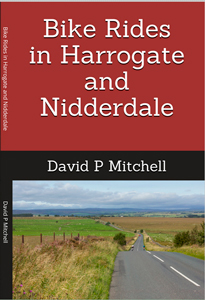
Bike Rides in Harrogate and Nidderdale is a book of family, mountain and road bike rides.
"This guide is a wonderful companion whether you ride alone, with family or friends. Don't set out without it."
Read more about Bike Rides in Harrogate and Nidderdale.


