Cycling in Yorkshire

Cycling in Yorkshire
Stage 14 | Stage 15 | Stage 16

Stage 15 of the Tour de France 2022 is a stage for the sprinters, but that doesn't mean there are no difficulties at all on the 202km yomp from Rodez south to Carcassonne. Christian Prudhomme thinks that if the sprinters' teams control the breakaway, they will bring everyone back together for a bunch sprint.
This is the Stage 15 TDF 2022 Blog.
| Date | Sunday 17th July 2022 |
|---|---|
| Stage classification | Flat |
| Distance | 202.5km |
| Intermediate sprint | Saint-Ferréol |
| Climbs | Côte d'Ambialet (Cat. 3) Côte des Cammazes (Cat. 3) |

There's an annoying video map of Stage 15:
This is the profile of Stage 15, Tour de France 2022:

| Caravan | Fast Schedule | Slow Schedule | |
|---|---|---|---|
| Start Time (départ fictif) | 1105 | 1305 | 1305 |
| Start Time (départ réel) | 1115 | 1315 | 1315 |
| Intermediate Sprint (147km) | 1445 | 1627 | 1645 |
| Côte de Cammazes (154.6km) | 1456 | 1637 | 1656 |
| Finish Line (202.5km) | 1604 |
1739 | 1804 |
Stage 15 starts in Rodez.

Rodez is a small city in the Aveyron département (Wikipedia).
The Celtic Ruteni tribe had a hill fort here from the C5th BC. When the Romans captured it, they called it Segodunum. Rodez was under English control during the Hundred Years War.
In the Middle Ages, Rodez was split between the centre inside the walls, which belonged to the Bishops of Rodez, and the area outside the walls owned by the Counts of Rodez.
In 1792, the French Revolutionary government set about introducing new units of measurement, which would apply throughout France and be trusted by everyone. The metre was one of the measurements, and its length was 1/10,000,000 of the distance between the North Pole and the Equator.
As part of the exercise of defining the exact length of a metre, two scientists shared the task of measuring the distance from Dunkirk to Barcelona, with Rodez as the mid-point. One of the scientists, Pierre Méchain, surveyed the southern section, but the worry about possible mistakes drove him mad. The other scientist, Jean-Baptiste Delambe, measured the northern section and made the final calculations to establish the exact length of a metre.
The building that dominates Rodez is the Cathédrale Notre-Dame, which is a mix of styles from the C13th to the C17th. Nearby, the Bishop's Palace dates from the C15th.

Leaving Rodez, the riders head south on the N88/D902 route de Cassagnes. Joining the Viaur river, they ride past the Abbaye Notre-Dame de Bonnecombe to Cassagnes-Bégonhès.

The riders continue on the D902, on rolling terrain. When they reach Réquista, they deflect off to the west on the D903, leaving the Aveyron département and entering the Tarn. The next village is Valence-d'Albigeois.
Next the D74 takes the peloton towards the river Tarn at Ambialet. There's a descent to the river near the Prieuré d'Ambialet.
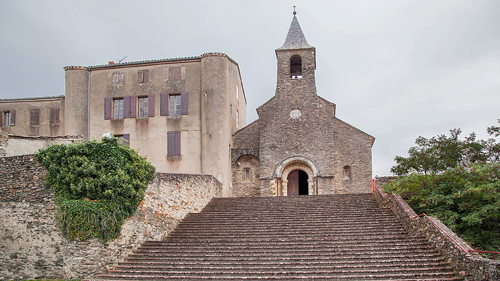
The race crosses the Tarn by a kayak hire place.
The pull up the other side of the river is quite steep. It's 4.4km at an average of 4.6%.
The route continues south west to Villefranche-d'Albigeois, Réalmont, Vielmur-sur-Agout and Puylaurens. The race then heads south to the rather bigger town of Revel.

The intermediate sprint is just after Revel, by a little lake called le Bassin de Saint-Ferréol.
After the intermediate sprint the road (the D626) twists upwards towards Cammazes. This is a Category 3 climb: 5.1km at 4.1%, to a height of 647m.
Stage 15 continues south east to Saissac, with the Montagne Noire looming to the riders' left. A few kilometres after Saissac, the race joins the D118 and takes aim for Carcassonne. It's mostly downhill from Saissac.
The approach to the finish line is on:

Carcassonne is a town of 46,724 people in the département of the Aude, on the river Aude and the Canal du Midi. It's dominated by the Medieval château surrounded by ramparts, la Cité de Carcassonne.
According to legend, it got its name from Carcas, the wife of a Saracen king. The Saracens in the city were besieged by Charlemagne. The king of the Saracens was captured and put to death. His wife, Carcas, continued to hold out. Her soldiers were dying of starvation, so she put scarecrows on the ramparts, and changed their hats every 2 hours, to make it look as though the sentries were changing over. Then she killed the last remaining pig, stuffed its belly with the last of the corn, and threw it over the walls. When it landed, the belly burst open to reveal the corn. Charlemagne's soldiers were amazed. They thought that even after the long siege, the Saracens were feeding their pigs with corn. Defeated, they packed up and began to leave. Carcas had the victory trumpets sounded, and Charlmagne's soldiers said 'Ecoutez, Carcas sonne' (listen, Carcas is sounding [the trumpets]). So the town got its name. Probably.
Carcassonne started as a Roman camp in the C1st AD. The Visigoths captured it as the Roman Empire crumbled, and it became part of the Visigoth kingdom of Toulouse. In 725, the Saracens took it from the Visigoths, and in 759, the Saracens were defeated by the Franks, under Pepin the Short.
Carcassonne belonged to the Counts of Toulouse, within the Frankish Empire, from the 800s to the 1200s. Peace and prosperity was disrupted from 1208, with the Albigensian Crusades. Catharism was a dualistic form of Christianity: according to the Cathars, there was a spiritual world ruled by God, and a material world governed by Satan. Cathars were regarded as heretics by the Roman Catholic church. When a Papal legate was assassinated in 1208, the Pope began a Crusade against the Cathars in the south west of France. In 1209, the Viscount of Carcassonne was defeated by Simon de Montfort.
The King of France exiled the inhabitants of Carcassonne for 7 years, and at the end of this time, he allowed them to build a fortified new town, or ville bastide, known as the Ville Basse (to the west of the river Aude), and to repair and strengthen the original fortress (to the east of the Aude). The fortress to the east of the river is what is known as la Cité de Carcassonne, and is the largest Medieval fortress in Europe. It was restored by Viollet-le-Duc in the C19th.
La Cité has a double curtain wall, with 14 towers on the outer wall, and 24 towers on the inner wall. Inside is the C12th Château Comtal, which was the home of the viscounts of Carcassonne, and the Basilique Saint-Nazaire, begun in 1096 in a Romanesque style, and completed in the 1200s and 1300s in a Gothic style.

Verse 1
Je me fais vieux, j'ai soixante ans;
J'ai travaillé toute ma vie,
Sans avoir, durant tout ce temps,
Pu satisfaire mon envie.
Je vois bien qu'il n'est ici bas
De bonheur complet pour personne.
Mon voeu ne s'accomplira pas:
Je n'ai jamais vu Carcassonne.
Verse 2
On voit la ville de là-haut,
Derrière les montagnes bleues:
Mais pour y parvenir il faut,
Il faut faire cinq grandes lieues;
En faire autant pour revenir!
Ah! si la vendange était bonne!
Le raisin ne veut pas jaunir:
Je ne verrai pas Carcassonne.
Verse 3
On dit qu'on y voit tous les jours,
Ni plus ni moins que les dimanches,
Des gens s'en aller sur les tours,
En habits neuf, en robes blanches,
On dit qu'on y voit des châteaux
Grands comme ceux de Babylone,
Un évêque et deux généraux!
Je ne connais pas Carcassonne!
Verse 4
Le vicaire a cent fois raison.
C'est des imprudents que nous sommes,
Il disait dans son oraison
Que l'ambition perd les hommes.
Si je pouvais trouver pourtant
Deux jours sur la fin de l'automne...
Mon Dieu que je mourrai content,
Après avoir vu Carcassonne!
Verse 5
Mon Dieu, mon Dieu, pardonnez-moi
Si ma prière vous offense;
On voit toujours plus haut que soi,
En vieillesse comme en enfance.
Ma femme avec mon fils Aignan,
A voyagé jusqu'à Narbonne:
Mon filleul a vu Perpignan.
Et je n'ai pas vu Carcassonne!
Verse 6
Ainsi chantait, près de Limoux,
Un paysan courbé par l'âge.
Je lui dis: 'Ami, levez-vous,
Nous allons faire le voyage'
Nous partîmes le lendemain;
Mais - que le Bon Dieu lui pardonne -
Il mourut à moitié chemin.
Il n'a jamais vu Carcassonne.
Il ne verra pas Carcassonne.
Gustave Nadaud

If Christian Prudhomme is right that Stage 15 will come down to a bunch sprint, then the hills shouldn't come into it - because the last 30km or so are downhill.
That means all the sprinters will be there, and it should come down to lead-out, positioning and speed.
Quite often, one sprinter gets on a roll and has a series of victories. At the time of writing I don't know who that will be.
At this distance, I'll say that the favourites include Fabio Jakobsen, Caleb Ewan, Wout van Aert and Dylan Groenewegen. The slightly more outside bets include Alberto Dainese, Alexander Kristoff and Peter Sagan.
Who do you think will win Stage 15?

Rough Guide to France.
Price £14.39 from Amazon as at 3rd March 2022.

The Montagne Noire is a mountainous area split between the Tarn and Aude départements.
The northern side is steeper, and covered in forests of oak, beech, pine and spruce. This northern side could be the origin of the mountain's name ('black'). On the less steep southern slopes, there are holm oaks, olive trees, vines, pines, and garrigue - Mediterranean scrub. From the south side, there are great views of the Pyrenees.
Wild animals living here include roe deer, wild boar, hares, and rabbits.
There are lakes on the Montagne Noire, which serve as reservoirs for the Canal du Midi.
The Pic de Nore is the highest point of the Montagne Noire, at 1,211m. It has a TV and radio transmitter on the top.

Bike Rides In and Around York features a historical city tour, plus family rides, road rides, and mountain bike rides.
"This book is simply a treasure trove not only of great rides but also as a travel guide to the area."
Read more about Bike Rides In and Around York.
Bike Rides in Harrogate and Nidderdale is a book of family, mountain and road bike rides.
"This guide is a wonderful companion whether you ride alone, with family or friends. Don't set out without it."
Read more about Bike Rides in Harrogate and Nidderdale.


