Cycling in Yorkshire

Cycling in Yorkshire

Stage 4 of the Tour de France 2023 is a 181.8km flat road stage from Dax to Nogaro.
Christian Prudhomme says that the hilly terrain of the Gers could suit a small breakaway group, but most likely the race will come back together for a sprint at Nogaro motor racing circuit.
The stage ends on an 800m straight to the finish line.
These are video highlights of Stage 4 Tour de France 2023.
This is the Stage 4 TDF 2023 Blog.
Race Details | Poll | Map & Profile | Timings | Videos | Food & Drink | Route Notes | Favourites
| Date | Tuesday 4th July 2023 |
|---|---|
| Stage classification | Flat |
| Distance | 181.8km |
| Intermediate sprint | Notre-Dame-des-Cyclistes |
| Climbs | Côte de Dému (Cat. 4) |
This is a map of the route of Stage 4, Tour de France 2023.

This is a zoom-able map of Stage 4 of the 2023 Tour de France.
This is the profile of Stage 4 Tour de France 2023.

| Caravan | Fast Schedule | Slow Schedule | |
|---|---|---|---|
| Start Time (départ fictif) | 1110 |
1310 |
1310 |
| Start Time (départ réel) | 1120 |
1320 |
1320 |
| Intermediate Sprint | 1331 |
1519 |
1531 |
| Côte de Dému Climb | 1455 |
1637 |
1655 |
| Finish Line (182km) | 1534 |
1712 |
1734 |
This is a video overview of Stage 4 Tour de France 2023.
This is a France 3 news report on the muted excitement among the 2,000 inhabitants of Nogaro in response to the news that they will host the arrival of a Tour de France stage.

Stage 4 takes place largely in the historic region of Armagnac, known for its Armagnac brandy.
Brandy is distilled wine. Armagnac is normally made from wine with a blend of grapes including Ugni blanc. The wine is distilled in column stills then aged in oak barrels.
Armagnac is distilled once, leaving it fragrant and flavourful, whereas Cognac is distilled twice for a higher alcohol content.
In 1310, Prior Vital Dufour listed some of the 40 virtues of Armagnac: 'it enlivens the spirit, if taken in moderation, recalls the past to memory, renders men joyous, preserves youth and delays senility'. It also cures hepatitis and dries tears, according to the good Prior.
Armagnac can be matched with an infinite number of dishes. Just drink some water as well, to prevent yourself getting thirsty and drunk. It works well with salmon and with lemon tart.
Café Gascon is coffee with a small measure of Armagnac alongside.

Stage 4 starts at Dax (départ fictif), a few miles inland from the Golfe de Gascogne, and sandwiched between the Pyrenees to the south and les Landes to the north.

Dax is a spa town of just over 20,000 people on the river Adour (Wikipedia).
It was established by the Romans as Civitas Aquensium.
From 1177, when it was acquired by Henry II Plantagenet as part of Aquitaine, it was ruled by the English. Only in 1451 did it become part of France again.
The Fontaine Chaude was built from 1814-18 under Louis XVIII (immediately after the fall of Napoleon Bonaparte). The water here is hot (86C), and was used to treat rheumatism.
Dax has a concrete bullring, and they still have a bull fighting festival in August. This horrific practice brings shame on the people who participate in it, and the town and region.
Les Madeleines de Dax are a sweet cake made by the Cazelle's bakery in Dax since 1906.
Rugby players Raphaël Ibanez and Christophe Lamaison hail from Dax.
The peloton rolls out of Dax going east. The départ réel is on the D32 Route de Montfort near Yzosse.
The race heads east to Monfort-en-Chalosse, the home town of Guy and André Boniface who were France rugby international players in the 1960s.

Stage 4 crosses the river Louts on the way to Mugron, which is in the Adour valley.
Like Dax, Mugron engages in the horrors of bull fighting, and the Tour de France website even promotes it on its heritage page. The Tour de France is supposed to promote the country as an attractive place to visit, yet in this instance it is being presented as backward and cruel.
The race continues to Saint-Sever, also on the river Adour.
Saint-Sever is built on the site of a Roman camp called Palestrion. It has a Benedictine abbey founded in the 900s to house the relics of Saint Sever (who had been killed by the Vizigoths in the 400s).
The abbey was rebuilt after a fire in 1060 using Cluny as its model. The abbey church dates from the 1100s.

The animal cruelty theme of Stage 4 continues at Saint-Sever, since it engages in bull fighting and produces foie gras.
The peloton continues via Saint-Maurice-sur-Adour and Grenade-sur-l'Adour. Both were founded as villes bastides (fortified towns) in the 1320s under Edward II, when Aquitaine belonged to the English.

Now Stage 4 leaves the Adour valley to head north. The next town on the route is Villeneuve-de-Marsan, before the riders continue to Labastide-d'Armagnac.

Labastide d'Armagnac was founded in 1291 by Count Bernard VI d'Armagnac, under the authority of King Edward I of England. It was initially called Bolonia.
Like most villes bastides, it has a grid of streets and a central square surrounded by arcades. The church and town hall look out onto the square, called Place Royale. Place Royale may have inspired Place des Vosges in Paris.
French King Henri IV is said to have stayed in a house overlooking Place Royale where one of his mistresses lived.

Skiing Made Easy is a practical guide to learning to ski based on many happy seasons of ski teaching.
It takes you through the beginner's progression from snowplough to parallel turns, starting at the very beginning and not assuming any prior knowledge.
The book suggests relevant exercises to develop and improve your skills. Common faults are identified, along with the best ways to correct them.
'By the way' sections contain information about many of the little things that people assume you just know, but you may not.
'This is the book I wish I'd had when I started skiing' - reviewer on Amazon.
How to buy:
Leaving Labastide d'Armagnac, the riders pass the chapel of Notre Dame des Cyclistes, where the intermediate sprint takes place.

The Chapelle Notre-Dame des Cyclistes is all that remains of a fortress of the Knights Templar called the Château de Géou - which was destroyed by the Black Prince in 1355.
It was Abbé Joseph Massie, known as 'the pope of cyclo-tourisme', who had the idea of making the old chapel a national sanctuary of cycling and cyclists. The Pope agreed to the designation in 1959.
The chapel is regularly visited by professionals, and the Tour de France has passed this way several times, most recently in 2017.
There's a Museum of Cycling inside, with jerseys donated by (amongst others) Anquetil, Louison Bobet, Tom Simpson, Hinault, Poulidor and Merckx.
Next on the race route is Cazaubon, then the riders pass the Lac de l'Uby. The roads then lead to Eauze.
Eauze, then called Elusa, was the capital of the Roman province of Novempopulania. The remains of the ancient city are at the eastern edge of modern Eauze
Today Eauze is home to the trade association of Armagnac brandy.

The peloton heads east to Courrensan, with its château perched above the Auzoue river.

A government minister called Patrick Devedijan was the owner of the château until his death in 2020 from Covid. Rugby coach Jacques Brunel was born in Courrensan.
Now Stage 4 loops south to Vic-Fezensac, on the Osse river, before heading west towards Dému. Here the riders encounter the one and only categorised climb, the Côte de Dému.
The Côte de Dému is 2km at an average 3.5%. The height at the top is 218m, after 154.4km raced.
The race continues via Manciet, on the rive Douze, and through Sainte-Christie-d'Armagnac, to Nogaro.

The parcours leads the riders to the Circuit Paul Armagnac, a motor racing venue which was founded in 1960 and is named after local driver Paul Armagnac who died while racing in 1962 during the Paris 1,000km.
The cycle race ends on an 800m finishing straight, which means that tactical positioning in relation to corners will not come into play. There's still the question of when to hit the front, especially if there's a headwind.
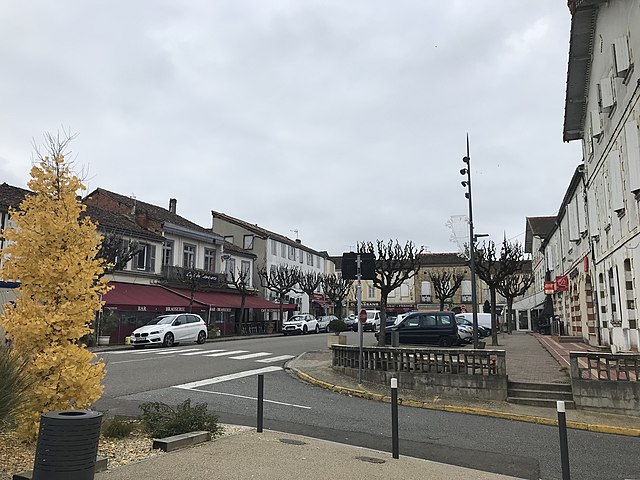
Nogaro has an Armagnac distillery.
It is also known for Floc-de-Gascogne, a liqueur wine made by mixing two-thirds grape must or grape juice and one-third young Armagnac. The result is a 16-18% alcohol drink for family consumption.
Michel Sarran is from Nogaro, and is a Michelin-starred chef with a
restaurant in Toulouse;.
Nogaro is associated with Spanish racing cyclist Luis Ocana, who won the 1973 Tour de France. He lived at a farm near to Nogaro, at Caupenne-d'Armagnac, and suffering illness and financial problems he committed suicide there in 1994.

Stage 4 of the Tour de France 2023 should suit sprinters like Dylan Groenewegen, Fabio Jakobsen, Jasper Philipsen, Jordi Meeus, Mark Cavendish and Caleb Ewan.
A long straight run to the line on a wide motor racing circuit means a lead-out could be vital. Michael Morkov is the best lead-out man in the business, and might deliver teammate Fabio Jakobsen to the perfect position with 200m to go, enabling the Belgian Soudal-Quick-Step sprinter to finish the job.
Who do you think will win Stage 4?

Mountains According to G. £8.59 in paperback on Amazon at the time of writing.

Techalogic DC-1 dual lens helmet cam.
Price £198.95 from Amazon at the time of writing.

New in May 2023, Bike Rides in the Yorkshire Dales is available in colour paperback.
Find out more about Bike Rides in the Yorkshire Dales or buy a copy.
Bike Rides In and Around York features a historical city tour, plus family rides, road rides, and mountain bike rides.
Find out more about Bike Rides In and Around York or buy a copy.
Bike Rides in Harrogate and Nidderdale is a book of family, mountain and road bike rides.
Find out more about Bike Rides in Harrogate and Nidderdale or buy a copy.

Labastide-d'Armagnac was founded as a bastide town in 1291 by Bernard VI d'Armagnac. Like all bastide towns, the streets are on a grid pattern, and there's a central square surrounded by buildings with arcades (place Royale). Originally, the town had defensive walls around it, but these no longer exist.
Henri IV is said to have stayed here on several occasions, and place Royale is supposed to have inspired him to create place Vosges in Paris.

How to Distill- a complete guide to the distillation process from still design to fermentation, through to aging spirits.
This page includes some affiliate links. If you click and buy a product, Hedgehog Cycling may receive a small commission.
This can help cover my costs; overall, running this cycling website is not a lucrative business.


