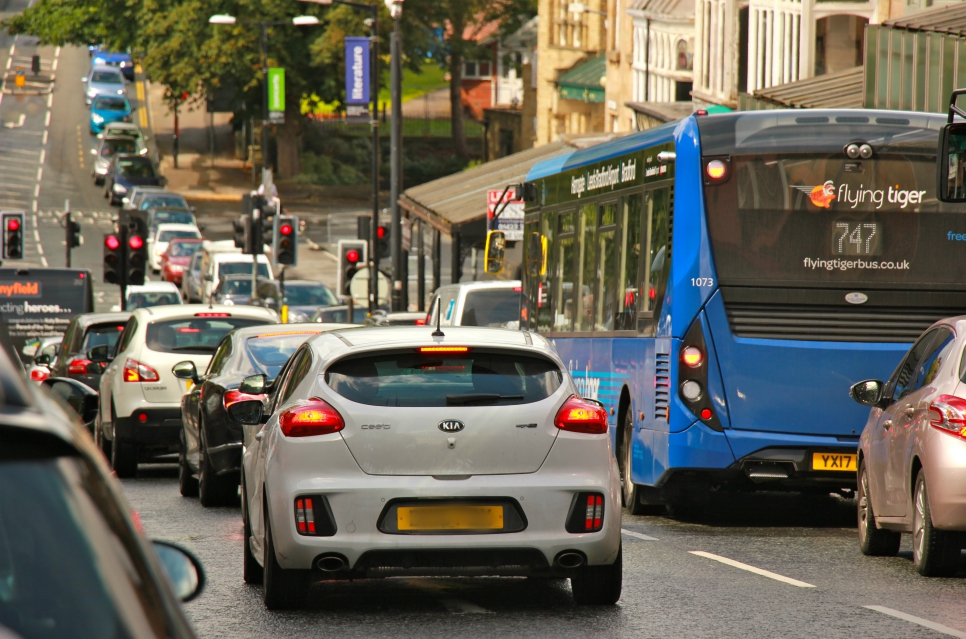
A so-called Harrogate relief road is
being promoted by North Yorkshire County Council's Business &
Environmental Services Executive ('the Executive'). The Executive
includes Councillors Don Mackenzie and Andrew Lee, and Corporate
Director David Bowe. A crude
map with coloured routes shows, roughly, the different
possible routes.
At an Area Committee meeting on Thursday 7th December 2017,
councillors voted 14-2 against continuing with the road proposal,
but the vote was ignored by the Executive, who decided
to push ahead with it.
Most of Harrogate's traffic is short, local journeys. In fact, 93%
of traffic in Harrogate is from journeys that begin or end in
Harrogate, or are entirely within Harrogate; only 7% is through
traffic. It's the people of Harrogate who are responsible for this
situation, not outsiders.
This helps explain why the name 'bypass' has not been chosen for
the unwanted road. A bypass option to the north of Harrogate that
only keeps non-local traffic out of the town would have little
effect.
Proponents of a new road would like to build it close to Harrogate,
through Bilton. They claim that it would cause a 20 to 40 per cent
reduction in traffic in Harrogate town centre.
Why Harrogate relief road is a terrible idea: a fatal flaw in the
reasoning

Roe buck, Bilton Lane
There's a fatal flaw in the reasoning of the would-be
road-builders. According to them, if you create more road space, you
reduce congestion. The idea has a certain simplistic attractiveness.
But is it true? We've been building roads since the 1950s or
earlier, and what has happened to congestion? It has increased.
Andrew Gilligan
Andrew Gilligan exposed the logical weakness of a similar argument
in his foreword to Human Streets, a
report in March 2016 at the end of Boris Johnson's term as Mayor of
London.
'Much of the opposition to cycle schemes is based on a belief that
motor traffic is like rainwater and the roads are drains for it. If
you narrow the pipe, these people say, it will flood. If you block
one route, they say, the same amount of traffic will simply flow
down the next easiest route. But that seldom or never actually
happens in practice. Because traffic isn't a force of nature. It's a
product of human choices. Our surveys tell us that huge numbers of
Londoners will choose to cycle if they feel safe doing so. If we
open up that choice, even more people will take it.'
Professor van Wee
[Update 30th October 2018] In an article about traffic jams in the
Netherlands, NOS.nl
quotes Bert van Wee, Professor of Transport Policy at TU Delft.
'Building more roads is in any case senseless. It is often the first
reaction from ministers who want to look as though they are doing
something. Of course you do sometimes have to make roads wider, and
re-work junctions, but if you think you're going to solve the
problem of congestion like that, you're wrong.'
Professor van Wee pointed to American research on the relation
between road-building and traffic jams. 'That study showed that
building more roads results in an increase in congestion.' The
road-building makes driving more attractive, he said. Instead, van
Wee suggests charging drivers according to when and how far they
drive. 'Research shows that can reduce traffic by 50%.'
City Lab article
Some of the US research is summarised in a
well-researched and thoughtful article in City Lab. It
explains that most new roads are sold to the public on the basis of
reduced congestion and faster journey times, but that's not what
happens.
'Rather than thinking of traffic as a liquid, which requires a
certain volume of space to pass through at a given rates, induced
demand demonstrates that traffic is more like a gas, expanding to
fill up the space it is allowed.' (A similar quote appears in an
interesting paper by Todd Litman).
Induced demand is complex, but it is real - despite the fact that
most public officials ignore it. It comprises latent demand - people
who got around in other ways or outside peak hours, because of
congestion - and generated demand - traffic that is a direct result
of new capacity.
Over the long term (3 years or more), induced traffic fills all or
nearly all of the new capacity. New roads also spawn autocentric
development patterns.
To anyone who is interested in the evidence, it is clear that
building roads does not solve congestion problems.
Trunk Roads and the Generation of Traffic
In 1994, the Standing Advisory Committee on Trunk Road Assessment -
the Department for Transport's advisors - looked at 'Trunk
Roads and the Generation of Traffic'. (Technically, the A59 is
a major A-road, not a trunk road, but there is no reason why
different principles should apply).
Specifically, they considered 'whether new or improved roads
generate extra traffic over and above the growth in traffic which
would be expected in the absence of any improvement to the road
network.' They consulted a large number of bodies and individuals,
and weighed a substantial volume of evidence.
The report has an Executive Summary. It says that accurate traffic
forecasts are central to an appraisal of the economic costs and
benefits of road schemes. One of the most complex forecasts concerns
whether improving the road system introduces extra traffic. This is
called 'induced traffic'. At the time, DfT forecasts assumed no
induced traffic. [Despite the advice of the Standing Committee, it
seems that this is still true].
All the evidence the Standing Committee examined tended 'to support
the existence of induced traffic'. Travellers respond to reductions
in travel time brought about by road improvements by travelling more
and further.
Studies show that 'increases in traffic counted on improved roads
are, in general, not offset by equivalent reductions in traffic
counted on the unimproved alternative routes.'
The Standing Committee's conclusion was that '...induced traffic
can and does occur, probably quite extensively...' with variations
depending on particular circumstances.
Further conclusions were:
- The economic value of a scheme can be overestimated by the
omission of even a small amount of induced traffic - this is of
'profound importance' to assessing value for money of a road
scheme
- Induced traffic is of greatest importance where the network is
close to capacity, particularly around urban areas; trips may be
supressed by congestion and then released when the network is
improved
- The consequences of trunk road improvements for the pattern of
land-use and development need to be considered
- Variable demand methods should become the normal basis of trunk
road traffic forecasts. Where networks are close to capacity,
suitable procedures must be used to represent the constraint of
traffic in the base case and the release of traffic growth in the
do-something case as additional capacity is provided. Using a
fixed demand approach is neither intellectually, nor in practical
terms, acceptable.
WSP
NYCC's consultants, WSP, are transport professionals. They ought to
know about induced demand, but it is not mentioned once in their November
2017 report, nor in the Addendum
Report of October 2018. It is an important theme, which they
need to address, because if the evidence on induced demand is
correct, any case for a new road crumbles.
If there are special factors in Harrogate and Knaresborough which
mean that the normal principles of induced demand don't apply here,
they should explain them. In any case, if they wish to maintain a
reputation for professionalism, and retain the confidence of the
people affected by this controversial issue, they cannot continue to
ignore the topic altogether.
Why Harrogate relief road is a terrible idea: Paris

Cycling
in Paris, by Jean-François Gornet, Licence CC
BY-SA 2.0
On 7th June 2018, Paris
reported a reduction in motor vehicle traffic of 6.5% in the
first 5 months of 2018, compared with the same period in 2017. The
percentage reductions in rush hour traffic are even greater. These
reductions are added to a 3% reduction per year between 2003 and
2013, and 4% per year between 2014 and 2016.
The reduction in traffic is having an impact: air pollution down
30% between 2003 and 2013.
The reductions in congestion and improvements to air quality in
Paris haven't come from opening up more space to private motor
vehicles. Parking charges have gone up, there are some car-free
days, cycle lanes have been built, and more cycle routes and
pedestrianisations are planned.
In Paris, the idea that reducing traffic reduces air pollution is
succeeding. In London, the Mayor is imposing restrictions on
polluting vehicles with an extension
of the Ultra Low Emissions Zone.
Why Harrogate relief road is a terrible idea: a congestion
generator road
What is the Executive's solution for Harrogate? Build another road
to improve air quality and reduce congestion! Does anyone actually
believe it will work?
What happens in practice is that a new road generates more traffic,
which spills over onto existing roads and junctions, and exacerbates
existing congestion and air pollution problems. When the Campaign for the
Protection of Rural England looked at bypasses built over the
past 20 years, they found exactly that: road schemes generate
traffic. They also result in a highly car-dependent pattern of land
development.
Harrogate residents currently make short, local journeys by car.
The fact that everyone else is driving everywhere means that the
roads are too hostile for them to consider cycling. It's a Catch 22
situation. There is some provision for cycling, but it's a million
miles from being a safe, convenient, complete network of
cycle routes.
We are finally seeing enlightened changes to transport systems in
some towns and cities around the world. What about us in Harrogate -
do we have the imagination to see how our town and borough could be,
if they were less dominated by motor vehicles?
The Executive wants to continue with the failed model of the past.
It wants to destroy a much-loved place, Old Bilton, and turn the
delightful Bilton Lane into a major road carrying 1,000 cars an
hour. Where now there is wildlife, peace, tranquility, recreation,
walking, and cycling, they want thousands of vehicles generating
noise and pollution - and inevitably increasing Harrogate's
congestion problems.
It mustn't be allowed to happen.