CPRE: the impact of road projects in England

Motorway
- No Thanks, by JL57,
Licence
CC BY-NC-SA 2.0
The Campaign to Protect Rural England (CPRE) produced a substantial
academic report on the impact of road projects
in England in March 2017. The report by Sloman, Hopkinson, and
Taylor is relevant to the proposal for a bypass or so-called
'Harrogate relief road'.
Conclusions of the CPRE report
The main conclusions of The Impact of Road Projects in England
report for CPRE are:
1) Road schemes generate traffic
The increases are +7% over the short term, 3-7 years, and +47% over
the longer term, 8-20 years
These are increases over and above background traffic growth.
2) Road schemes have long-lasting negative impacts on landscape
and biodiversity, and because they generate traffic, they increase
CO2 emissions
One of many examples given in the report comes from the case-study
in Blackburn: 'South of Blackburn, the environment where the road
crosses the Stanworth Valley remains poor, with rather sparse tree
cover and poor ground cover under the viaduct, in place of ancient
woodland and rich bird and plant life that existed previously.
Footpaths that were re-located and now run alongside the motorway
are subject to noise and visual intrusion. Large numbers of houses
along the route are also subject to noise impacts.'
3) In the majority of cases studied, there was no evidence of
economic benefits
In buoyant economic areas, road schemes can result in development
in car-dependent locations, causing rapid traffic growth and
congestion on the road scheme and pre-existing road network.
4) There is a mixed effect on road safety
But increased traffic in the the long-term is likely to result in
more more collisions causing serious injury or death.
5) Road schemes result in a highly car-dependent pattern of land
development
This includes housing developments in the countryside, from which
the vast majority of trips are by car, and business and retails
parks generating traffic and causing congestion.
'This pattern of road building and associated land development is
leading to a semi-industrial/urban landscape in the countryside, and
the erosion of Green Belt that was originally designated to prevent
sprawl. It is a major cause of the high levels of traffic growth
associated with road schemes in the long term.'
The report identifies a vicious circle of road building generating
traffic and creating a demand for more road-building: 'The case for
more road building was (and is) partly justified on the basis that
existing roads cannot take the strain any longer...However,
provision of more road capacity does not deliver a stable situation
- the more capacity is increased, the more capacity increases are
'needed'.
Alternatives to new roads
What is the alternative? The report suggests:
- *focusing housing and development in towns around rail stations,
and where walking and cycling are practical
- *invest in new high-quality rail corridors
- *measures to discourage road use at peak times including road
pricing and levies on workplace car parking
- *reform of the way road schemes are appraised
The evidence on which the report is based
The report is based on data published by Highways England through
its Post-Opening Project Evaluation (POPE) process. In the data is
evidence from 80 road schemes of short-term impacts (1-5 years after
opening). This is supplemented by long-term evidence from four road
schemes completed between 13 and 20 years ago. The four older road
schemes are the A34 Newbury Bypass, the M65 Blackburn Southern
Bypass, the A46 Newark-Lincoln dualling, and the A120 Stansted to
Braintree dualling.
Traffic increases in four cases studied
These graphs show the increase in traffic at the four road schemes,
as compared with the background increase in the local area.
Newbury:

Blackburn:

North Lincolnshire:

Essex:

CPRE report: relevance to Harrogate
The CPRE report is highly relevant to Harrogate, where North
Yorkshire County Council have proposed a bypass to the north and
east of the town. The routes can be seen on Nidd Gorge
Community Action's website.
In reality, what is being proposed is a bypass. The name 'relief
road' has been given to it by those proposing the project,
presumably because they think that is pyschologically less
unappealing than bypass.
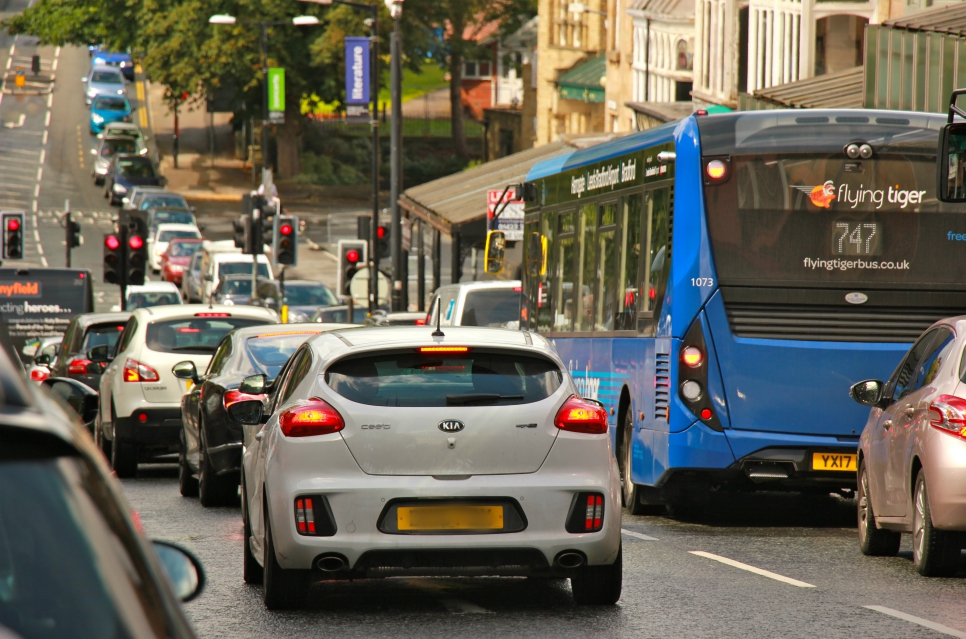
The stated reasons for wanting to build a new road in the
countryside are to reduce congestion in Harrogate and Knaresborough.
However, the council's own figures show most vehicles are on short,
local journeys, and a bypass would do nothing to alleviate the
congestion they cause. The CPRE report demonstrates that in any
event, new roads generate more traffic and create more congestion.
Comments in the local press have been made by one councillor, to
the effect that nothing is going to happen for a very long time, so
people should 'get down off the barricades.' This rule doesn't apply
to the councillor himself, though, who talks about the road proposal
every time he is given space in the local paper.
Similarly, there have been comments to the effect of, 'of course
we're not going to build over the Nidderdale
Greenway or by the Nidd Gorge'. But if that were true, why
have it as one of the proposals at all?