Active travel is good for our health in many different ways; travel
by private car is bad for our health in many different ways.
Made to Move
In his role as Walking and Cycling Commissioner in Greater
Manchester, Chris Boardman produced a report called Made to Move. It contains a
chapter headed 'The Way We Travel is Killing Us'.
The chapter notes that, according to the Royal College of
Physicians, air pollution causes 40,000 premature deaths per year in
the UK, at an estimated social cost of £22 billion per year.
Children suffer with asthma due to excess motor traffic. As the
average number of walking trips has dropped by 16% over the last 20
years, obesity has increased, especially among children. In
Manchester, the cost of physical inactivity to the NHS is more than
£500,000 per week.
Public Health England
In a report in May 2016 called Working
Together to Promote Active Travel, Public Health England noted
that 'walking and cycling are good for our physical and mental
health...[and] will improve health, quality of life and the
environment, and local productivity.'
Some of the report's key points echo those in Made to Move.
Physical inactivity directly contributes to 1 in 6 deaths in the UK
and costs £7.4 billion a year to business and wider society.
Physical activity is called an under-rated 'wonder drug'.
The growth in road traffic has been a major factor in reducing
levels of physical activity and increasing obesity. It also results
in road traffic collisions and injuries (2,082 children killed or
seriously injured in 2014), air pollution, noise, and reduced social
cohesion and increased social isolation for many.
People living in a street with heavy traffic have fewer friends and
acquaintances on the street than those living in a quiet one.
Short car trips (under 5 miles) are a prime area for switching to
active travel and to public transport.
UKHACC
[Update 30th October 2018] The UK
Health Alliance on Climate Change produced a report today,
which notes some of the damaging effects of air pollution caused by
motor vehicles. They include asthma, emphysema, bronchiectasis,
chronic obstructive pulmonary disease, cancer, stroke and dementia.
Professor Jonathan Grigg of the Royal College of Paediatrics and
Child Health described the situation in 2018, where children playing
outside or walking to school are affected by toxic levels of air
pollution as 'a disgrace'.
The report calls for a new Clean Air Act, with legally binding
standards of air quality, and for investment of £10 per head in
active travel.
Harrogate & Knaresborough
The evidence is clear: pollution from vehicles is a disaster for
our health, and our children's health. The way we travel needs to
change.
Short trips which could easily be walked or cycled
In their November
2017 report on the Congestion Generator Road for North
Yorkshire County Council, consultants WSP noted (paragraph 2.6.4)
that trips that are purely internal to Harrogate and Knaresborough
make up nearly half of all trips. External to external trips are
only 7%.
The average distance of internal trips within Harrogate alone
(rather than Harrogate & Knaresborough), which is about 37% of
all trips in the district, is 2.6km (paragraph 2.6.5). That is 1.6
miles - a moderate walk, or a short cycle ride.
In Harrogate and Knaresborough, there is huge scope to increase the
amount of active travel. Distances are generally short. It is an
enjoyable way of getting around, and it will be good for us. But
there has to be a complete network of routes that are safe and
attractive. The more you ask people to share routes with speeding
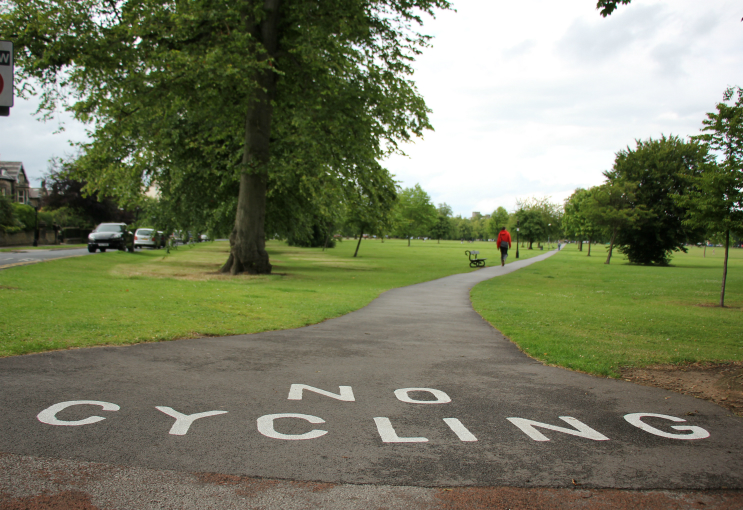
cars and trucks, the less they will cycle or walk. People would like routes in parks away
from traffic. Instead, in Harrogate they are given 'no
cycling' notices painted in huge letters.
A new road means more traffic, more pollution, less active travel,
and more health problems
The NYCC Executive promoting a new road are intent on more of what
we've had in recent decades - more traffic, more pollution, more
divided and isolated communities and individuals, more road danger,
and more health problems related to inactivity.
Motor vehicles are not benign and neutral. They do drive everything
else off the roads. Apparently, school children can't even go on a
trip to the park without being made to wear high-viz gilets. Surely
there is a design fault with our roads if the onus is being put on
potential victims to avoid being hit by traffic.
We need vehicles, and we're never going to get rid of them
completely, but it's vital that they don't dominate everywhere, and
ruin our health and quality of life.
This Congestion Generator Road project demonstrates a lack of
vision, and a lack of will to change things in a positive way. It
shows a determination to repeat all the mistakes of the past, and
not to learn from them.
A new approach
What's needed is a new approach for healthy people and liveable
places.
Walking and cycling should be prioritised, for health reasons and
because it will make our town so much more pleasant. Where motor
traffic creates danger and pollution in the places where people
live, work, and shop, it should be calmed and restricted. There
should be top-quality provision for walking and cycling in town and
residential areas, and priority should be given to those who choose
to travel that way.