ECF Safer Cycling Advocate Program
17th January 2020
The European Cyclists' Federation (ECF) has produced a guide for organisations looking to encourage cycling and improve road safety. It is called the Safer Cycling Advocate Program, and it's based on Dutch and Danish expertise and best practice.
Introduction
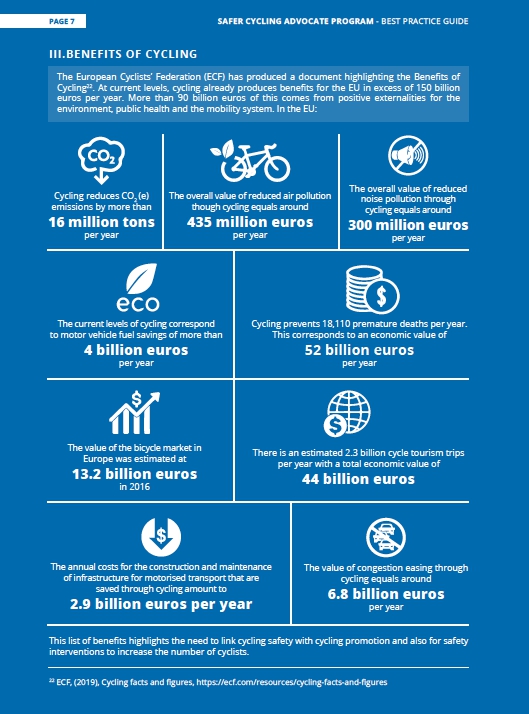
The Introduction stresses the benefits of cycling (see graphic above).
It also explains the Safe Systems Approach (SSA), which aims to ensure a safe transport system for all road users, taking account of the fact that we're all human and make mistakes. Priority is given to human life and health, rather than favouring a cost-benefit analysis of safety measures. That includes valuing the health benefits of active travel, and for example checking that a road safety intervention doesn't act as a barrier to cycling.
The Introduction also assesses Electric Power Assisted Cycles (EPACs). Evidence shows that often EPACs replace car trips, not public transport, so they have the potential to reduce congestion. Health benefits of EPACs are similar to ordinary bicycles.
Road user behaviour
This section includes comments on how the bicycle helps Dutch children establish their independence and connect to a wider network of friends, resources, and institutions. It also has a sub-section on the role of the police using bikes, and says that it makes officers more approachable than when travelling by car.
Infrastructure
This is a major section of the document, and there's a lot of information - but well worth reading and absorbing.
Five design principles for cycling infrastructure
These principles are aimed at safety, comfort, and ease of use.
- Safety - cycling infrastructure should guarantee the safety of cyclists and other road users; one aspect of this is that those on a particular piece of infrastructure should have similar mass/speed/direction
- Comfort - including a good surface, space for overtaking, as little stopping as possible, no obstacles in the road, and as few turning manoeuvres as possible
- Directness - as short a route as possible, and traffic lights set in favour of the cycle route
- Attractiveness - socially safe and running through well-designed and maintained public spaces
- Coherence - this 'has to do with the ability to get somewhere and with the need for a complete and comprehensible bicycle infrastructure. Connections connect to (all) origins and destinations of cyclists'
When to build segregated cycling infrastructure
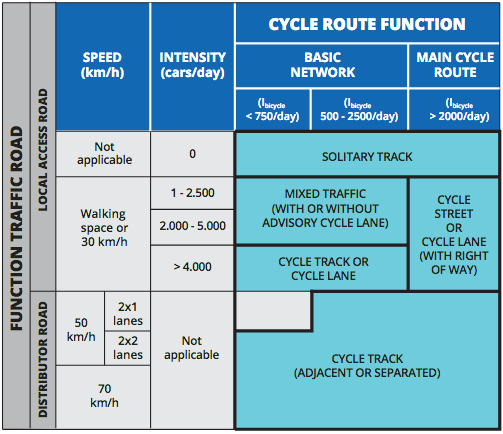
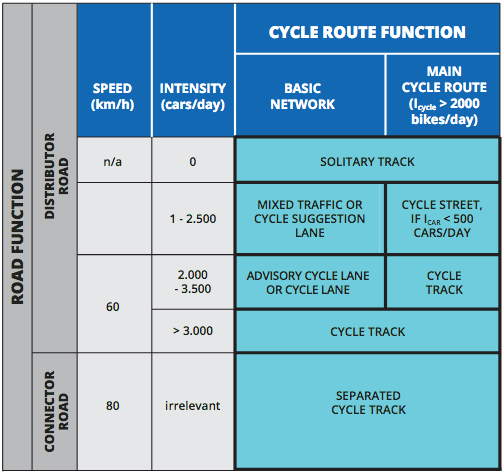
The principles of when to separate cyclists from motorised traffic are based on traffic speed and volume. There are two separate matrices, for inside and outside urban areas.