Yorkshire cycling website

Stage 3, Tour de Yorkshire 2019

Stage 3 of the Tour de Yorkshire 2019 is on Saturday 4th May 2019. It's 135km from Bridlington to Scarborough, and it's called the Yorkshire Coast.
Stage 3, men's Tour de Yorkshire 2019: race result

Alexander Kamp (Riwal Readynez) won Stage 3 of the men's Tour de Yorkshire 2019. The Dane beat Chris Lawless in a sprint at Scarborough's North Bay.
This is a video summary of the women's Stage 2/men's Stage 3 TDY 2019.
Stage 2, women's Tour de Yorkshire 2019: race result
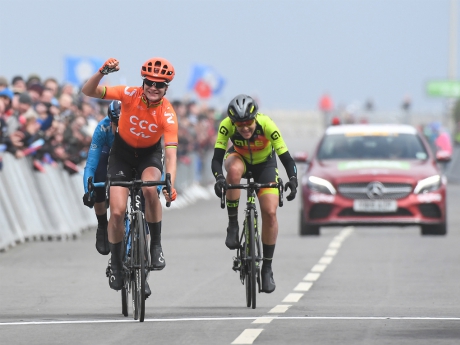
Marianne Vos (CCC-Liv) won Stage 2 from a leading group of three. She also won the General Classification.
Stage 3, Tour de Yorkshire 2019: map, facts, and figures
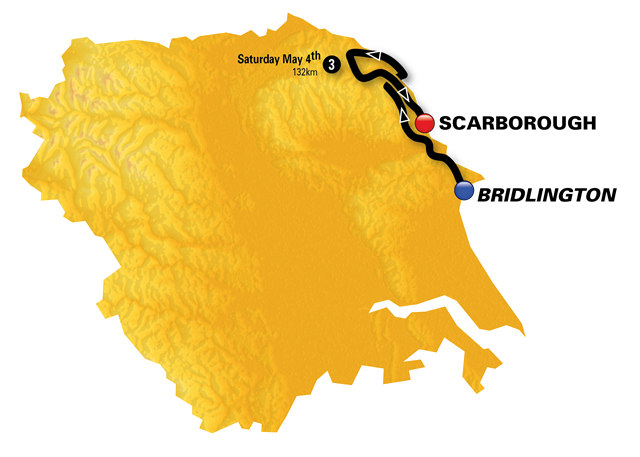
Welcome to Yorkshire have a detailed map of the race route.
| Date | Saturday 4th May 2019 |
|---|---|
| Stage classification | Hilly |
| Distance | 135km |
| Intermediate sprints | Harwood Dale Whitby Abbey |
| Climbs | Côte de Silpho Côte de Hooks House Farm, Robin Hoods Bay Côte de Lythe Bank Côte de Grosmont Côte de Ugglebarnby |
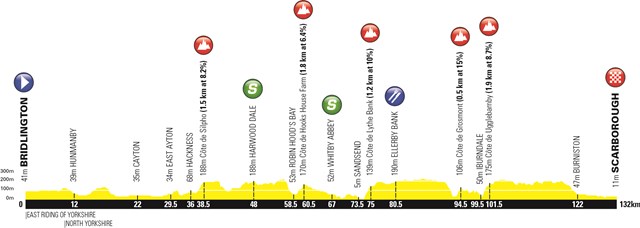
The riders set off from Bridlington at 1445 (amended timing) and arrive at the finish line in Scarborough between 1737 and 1754 (?this may also be 15 minutes later). See the full race timings for Stage 3 TDY 2019.
Stage 2, Women's Tour de Yorkshire 2019

The women's Tour de Yorkshire 2019 has two stages. The second is on Saturday 4th May 2019, and takes exactly the same route as the men's Stage 3.
The women set off from Bridlington at 0905, sprint near Whitby Abbey around 1100, and reach Scarborough between 1244 and 1309. See the full timings for the women's Stage 2, Tour de Yorkshire 2019.
Stage 3, Tour de Yorkshire 2019: the route
Stage 3, Tour de Yorkshire 2019: the start in Bridlington
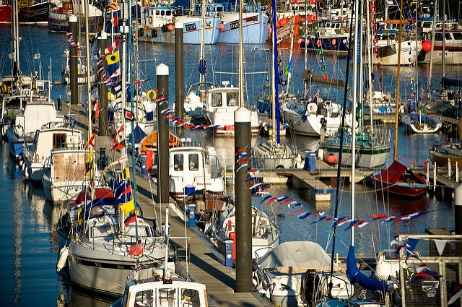
The riders start at the Spa, Bridlington, and take Marine Drive and South Cliff Road past Bridlington Harbour. After heading north to the Old Town, they leave Bridlington on Scarborough Road.
Stage 3, Tour de Yorkshire 2019: Bridlington to Whitby
The road (the A165) reaches 107m at a mast west of Bempton. It's undulating terrain. The race turns off the A165 to Hunmanby.
The riders are on a minor road heading west from Hunmanby. They descend Flotmanby Brow (a typical Yorkshire Wolds slope) to the A1039, and after a very short stretch of the main road, continue north through Folkton. They're now on the flat land of Folkton Carr, and cross the river Hertford before reaching Cayton.
From Cayton, the peloton heads west on the B1261 to Seamer and East Ayton. They pass Ayton Castle, and head up through Forge Valley Wood and Scarwell Wood to Hackness.
From Hackness, the road rises towards the hamlet of Silpho, and this is the first categorised climb on the stage, the Côte de Silpho.
At the T-junction after Silpho, the riders turn left and head into Broxa Forest. Next is Harwood Dale Forest, and it is host to the first intermediate sprint of the day, just before the junction with the A171 Robin Hoods Bay Road.

Now the race takes the A171 across Fylingdales Moor. The race route forks right. There's a steep down-and-up dip on the way to Fylingthorpe and Robin Hoods Bay.

Leaving Robin Hoods Bay on the B1447, it's steeply uphill. This is the second categorised climb, the Côte de Hooks House Farm, Robin Hoods Bay; it peaks at 169m.
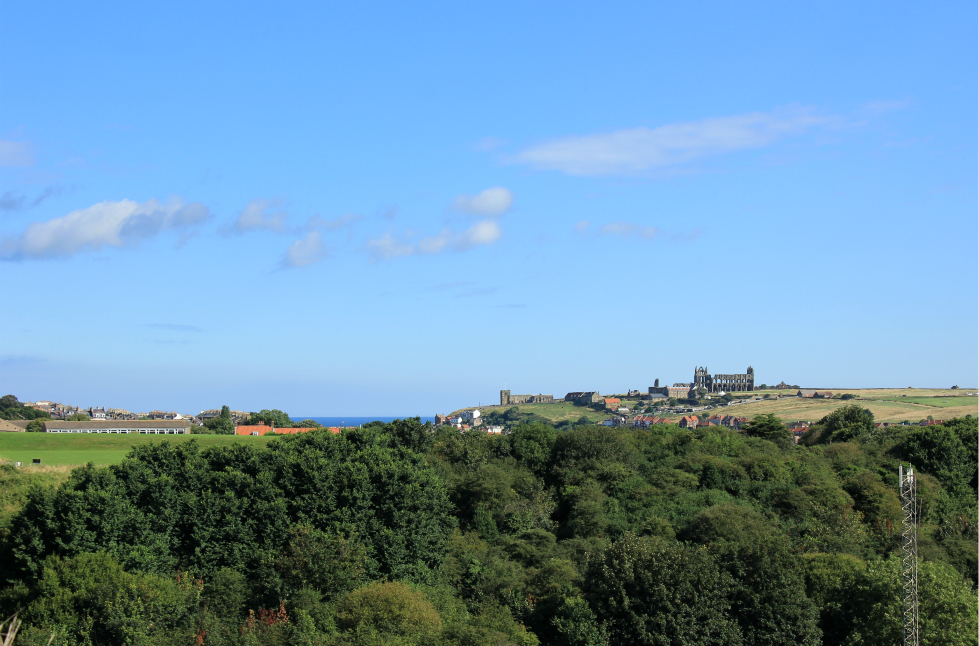
After a short stretch of the A171 at Hawsker, the riders take Hawsker Lane towards Whitby Abbey. The second intermediate sprint is within sight of the Abbey.
Then they go down Green Lane and onto Church Street, then across the bridge over the river Esk by Whitby Marina.
Bagdale takes them up to Pannett Park, and they leave Whitby on Sandsend Road, passing the golf club.
The peloton will be right by the seafront at Sandsend. Then they climb away from the North Sea, on the A174, up Lythe Bank. This is the third official climb of the stage, and the summit is by the church at the top of Lythe Bank.
The riders continue west on the A174, through the village of Lythe, past Mickleby, and across Mulgrave Moor. They meet the A171, and turn left; they reach 224m near Frankland's Farm. Soon after, they turn off the main road, and head for Egton.
This is the North York Moors. From Egton, it's downhill to Grosmont, a village with a station that serves the Esk Valley railway and the North York Moors railway.
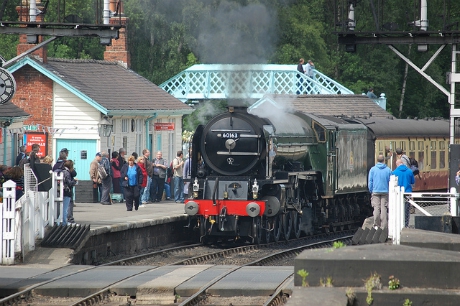
It's steeply uphill out of Grosmont, and this is the fourth climb of the day, the Côte de Grosmont. The route doesn't take the riders all the way up to Black Brow; instead, they fork left on Eskdaleside, on the valley side above the river.
They pass Sleights and go through the hamlet of Iburndale, on Little Beck. From there, it's uphill to Ugglebarnby; the climbing continues beyond the village to the top of the Côte de Ugglebarnby (around 180m). This is the fifth categorised climb.
After the top of the climb, Dean Hall Brow takes the riders to the B1416; the B-road takes them a few kilometres to the A171.
Now it's south on the A171 across Fylingdales Moor, retracing their steps (or pedal strokes) from earlier in the day. They continue on the A171 through Harwood Dale Forest, and to Cloughton and Burniston.

In Burniston, it's a left fork on the A165, and this brings the pack into Scarborough.
On the A165, they cross Scalby Beck and Peasholm Park. There, they fork left off the A165, and take North Marine Road, St Thomas Street, St Nicholas Street, Vernon Road, and Foreshore Road.

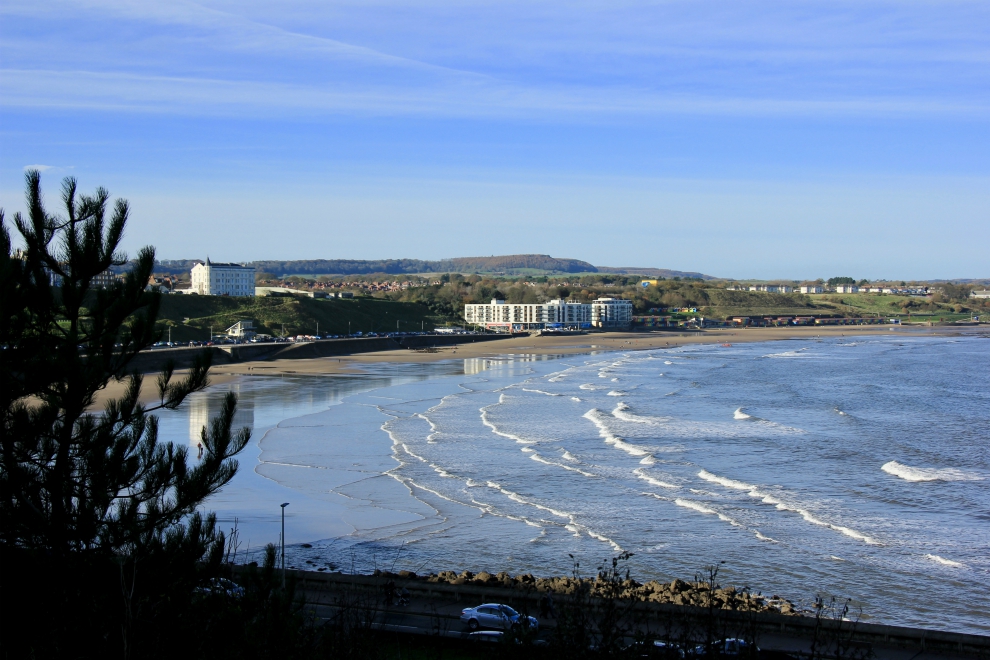
Foreshore Road leads past South Bay and the harbour. It turns into Marine Drive, which takes the riders around the promontory, with Scarborough Castle ruins up to their left.
When they come round to North Bay, they'll see the finish line on Marine Drive, by Royal Albert Park.
UCI
2019 World Champs Yorkshire

News and route guides for the UCI 2019 event in Harrogate.
Read about the 2019 UCI World Championships in Yorkshire.
Stage 3, Tour de Yorkshire 2019: towns & places of interest on the route
Stage 3, Tour de Yorkshire 2019: Bridlington
Bridlington is a town on the North Sea coast, just south of Flamborough Head. A little river called the Gypsey Race runs through it.
Bridlington has probably been inhabited since the Bronze Age, and there may have been a Roman settlement. It was mentioned in the Domesday Book as Bretlinton. The town grew around an Augustinian Priory founded in 1133.
Today, Bridlington lives mainly from tourism, but is also a minor sea fishing port, known for shellfish.
Stage 3, Tour de Yorkshire 2019: Whitby
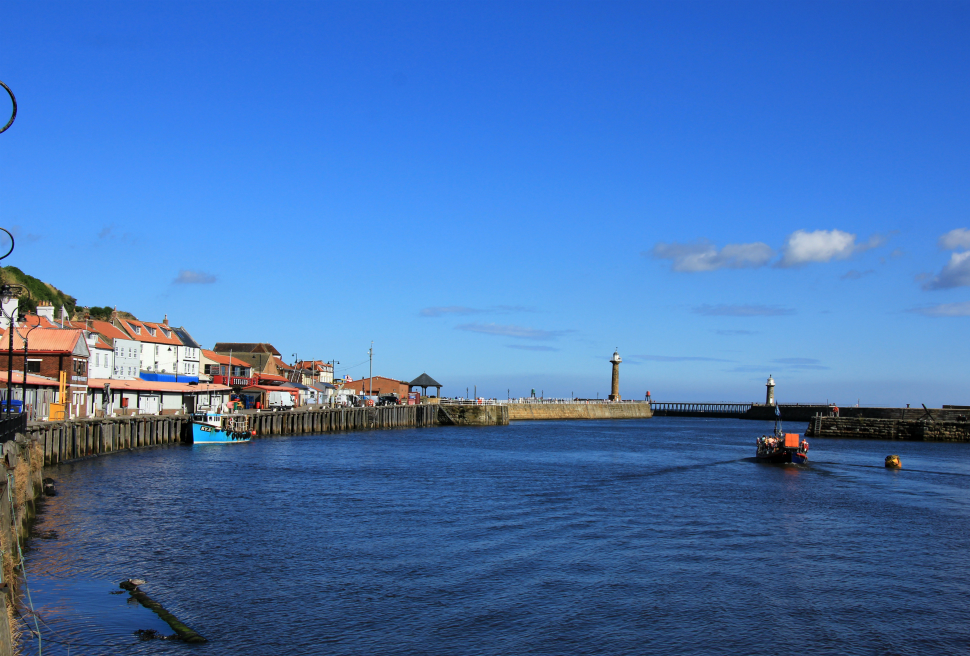
Whitby is a seaside town at the mouth of the river Esk.
The settlement here was called Streanoehealh in 657AD when a monastery was founded by King Oswy of Northumbria. It became known as Witebi, meaning 'the white settlement' in Old Norse, in the C12th.
The first Abbess of the monastery was St Hilda. Caedmon was transformed into an inspired poet at the Abbey. The Synod of Whitby (664) established the date of Easter in Northumbria, the Roman date being adopted in preference to the Celtic one.
The monastery was destroyed by Danish Vikings between 867 and 870, and only re-established under the Normans in 1078, when William de Percy gave the land to the Benedictine Order.
The town of Whitby grew after the Dissolution of the Monasteries, particularly due to trade in alum found locally, and used for medicine, curing leather, and fixing dyed cloths. There was also a local shipbuilding trade, and (from 1795) Whitby became a whaling port. A whalebone arch on West Cliff commemorates this period. There's also a statue of Captain James Cook there.
Whitby was a spa town in the late 1700s and early 1800s, with visitors drawn by three 'chalybeate' springs. More tourists arrived after the Whitby and Pickering railway was built in 1839.
In the Victorian period, jet was mined from the cliffs and moors, and Whitby Jet became well-known. (The Romans had already mined jet). Jet is a mineraloid which is the compressed remains of ancestors of the monkey-puzzle tree. It can be used to make jewelry and decorative items, and Queen Victoria liked it, especially after Albert's death. Fossils have also been found in Whitby's cliffs.
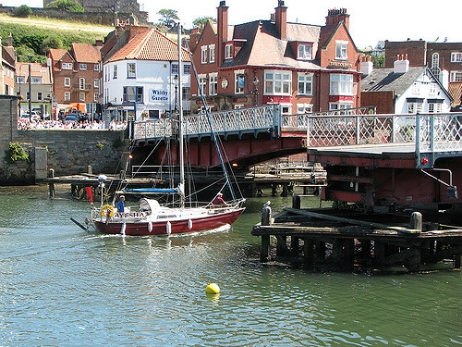
The main industries today are fishing and tourism. Amongst other things, visitors patronise the many local fish and chip shops, including the Magpie Café. Whitby is the closest port to a proposed offshore windfarm on Dogger Bank.
Whitby is associated with Dracula, because part of Bram Stoker's novel is set here.
Whitby is twinned with Anchorage, Alaska.
Stage 3, Tour de Yorkshire 2019: Robin Hood's Bay
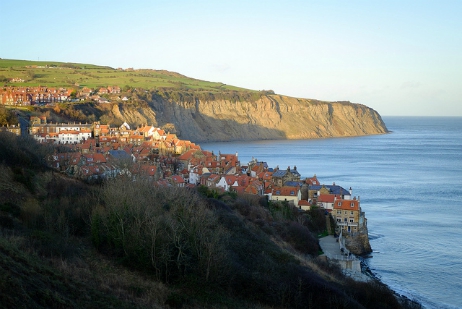
Robin Hood's Bay is a small fishing village within the North York Moors National Park, which is picturesque, and popular with visitors. It is built in a fissure between two steep cliffs, and most of the houses are sandstone, with red-tiled roofs.
The origin of the name is uncertain, but a legend says that Robin Hood encountered French pirates, and made them surrender. He took their loot, and returned it to the poor people of the village which is now called Robin Hood's Bay.
There were settlements slightly inland (at Raw and Fylingthorpe) in the Viking and Norman eras, but it wasn't until the 1500s that Robin Hood's Bay itself was inhabited. In 1536, about twenty fishing boats were moored here.
Robin Hood's Bay has a tradition of smuggling. There may be underground passages linking the houses. In the late 1700s, contraband tea, gin, rum, brandy, and tobacco were smuggled from the Netherlands and France. There were battles between smugglers and excise men on at least two occasions.
Fishing reached its peak in the mid-1800s, with the fish carried over the moorland to Pickering or York. Tourism generates the most income today.
The Bay is on what is sometimes called the Dinosaur Coast, and many fossils have been discovered.
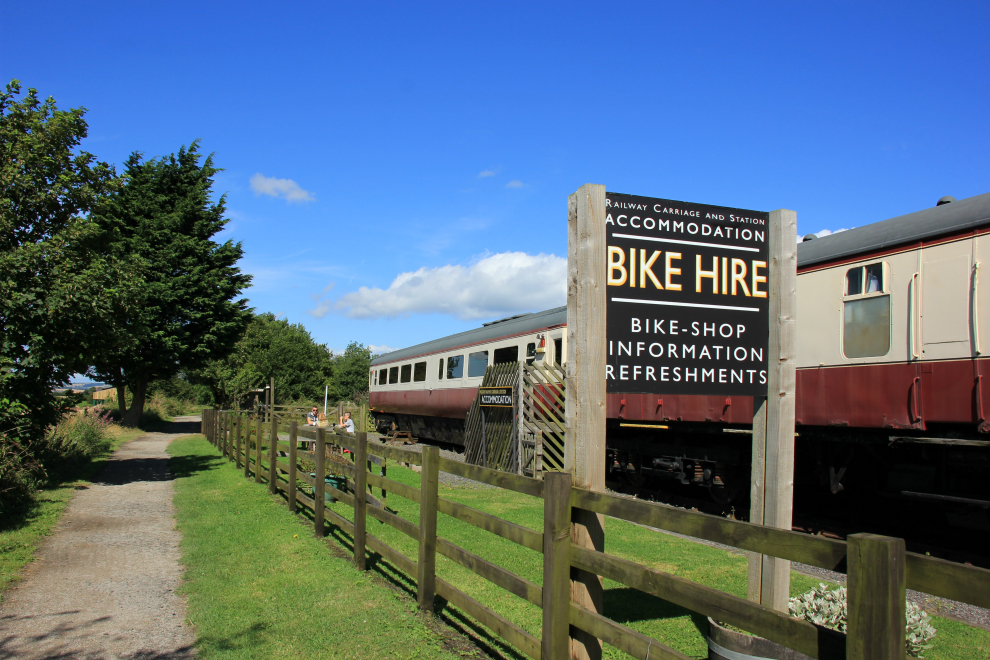
Robin Hood's Bay had a station until 1965, when the Scarborough and Whitby line was closed. The old railway line is now used for the Cinder Track foot and cycle path.
Stage 3, Tour de Yorkshire 2019: Scarborough
Scarborough is the largest holiday resort on the Yorkshire coast. As well as tourism, Scarborians live from fishing, services, and the digital and creative industries. There's free wifi on the town's seafront and harbour.
The rocky promontory, with the ruins of Scarborough Castle on it, separates the sea front into North Bay and South Bay. South Bay is more popular and commercial, while North Bay is quieter, and has the Japanese-themed Peasholm Park. The miniature North Bay Railway runs from the park to Scalby Mills and the Sea Life Centre.
Scarborough may have been founded around 966AD as Skaroaborg by a Viking raider, but there was little left of any settlement by the time of the Domesday Book.
Scarborough Castle was built under Henry II, and he granted charters for a market in 1155 and 1163. The royal charter for Scarborough Fair was granted in 1253. It was a 6-week trading festival, with merchants from all over Europe, and it continued for about 500 years. The castle and town suffered during the English Civil War of the 1640s, and they were badly damaged.
Scarborough's history as a spa town began when a spring was discovered in 1626, and more visitors came after it was publicised by Dr Wittie's book in 1660. The Scarborough to York railway (1845) meant further popularity.
Scarborough is associated with Alan Ayckbourn, and almost all his plays receive their first performance at the Stephen Joseph theatre.
The Rotunda museum is a national centre for geology - appropriate, as Scarborough is on Yorkshire's Jurassic Coast.